
Services · Fire
Fire protection
Hydrants and pumps, sprinklers, detection, CO2 flooding and suppression systems.
Detect early, prevent fire spread, protect life and property. Amtech engineers complete fire fighting, alarm, detection and suppression systems for buildings and industry.
- Hydrants & pumps
- Sprinklers
- Detection & alarm
- CO2, FM-200 & foam
Fire fighting works
We provide the following fire fighting works
- Hydrants and Pumps
- Sprinklers System
- Detection System
- Co2 Flooding System
Supply / Service / Maintenance of fire fighting system hydrant, sprinkler & extinguisher, fire pump house, fire alarm system, fire suppression system, clean agent, FM-200, CO2 and foam suppression system, wet, dry and deluge sprinkler system.


Hydrants and pumps
Hydrants and pumps are essential components of many fire protection systems, providing the water flow and pressure required to control or extinguish fires in residential, commercial, industrial, and infrastructure facilities. A fire hydrant system typically includes hydrant points, piping, valves, hoses, landing valves, hose reels, and other associated equipment. The system is connected to a dedicated water source and supported by pumps that maintain the required pressure and flow. Fire pumps are generally used to move water from a storage tank or other approved water source into the fire-protection network. Depending on the system design, the pump arrangement may include a main fire pump, standby pump, and jockey pump. The jockey pump helps maintain system pressure during normal conditions and reduces unnecessary starting of the main pump. Hydrant systems are particularly useful for buildings, factories, warehouses, commercial complexes, power facilities, and other properties where firefighting personnel may need a reliable high-flow water supply.


Sprinklers system
A sprinkler system is an automatic fire-protection arrangement designed to detect heat from a developing fire and release water over the affected area. It is widely used in residential buildings, offices, warehouses, factories, hotels, shopping centers, hospitals, and other facilities.
The primary purpose of a sprinkler system is to control or suppress a fire during its early stages, helping limit fire growth and reduce potential damage.
A typical system includes sprinkler heads, distribution piping, control valves, water-supply equipment, alarm devices, and associated monitoring components. The exact configuration depends on the building, the hazard and the applicable design standards.


Detection system
A fire detection system is an important safety installation designed to identify the early signs of fire and provide timely warning to people inside a protected building or facility. It is commonly used in commercial buildings, factories, warehouses, offices, hotels, hospitals, educational institutions, residential complexes, and other locations where early fire notification is essential.
A modern detection system can combine several types of devices, including smoke detectors, heat detectors, flame detectors, manual call points, alarm sounders, visual indicators, control panels, and communication modules. Each component performs a specific function within the overall fire-safety arrangement. Smoke detectors are generally selected for areas where smoke is expected to be an early indication of fire. Heat detectors may be more suitable for locations where dust, fumes, steam, or other environmental conditions could cause unwanted smoke-detector activations. Flame detectors can be used for selected industrial applications where fires may develop rapidly.


CO2 flooding system
A CO2 flooding system is a fixed gaseous fire-suppression system designed to extinguish fires by releasing a calculated quantity of carbon dioxide into a protected enclosure. It is primarily intended for specially selected hazards where rapid suppression is required and the use of water or other extinguishing agents may be unsuitable. Carbon dioxide suppresses combustion by reducing the concentration of oxygen surrounding the fire. When the required concentration is achieved and maintained for the specified period, combustion can be interrupted. CO2 flooding systems may be considered for certain industrial machinery, electrical equipment areas, process facilities, engine rooms, storage areas, and other enclosed hazards where the system can be engineered appropriately. A typical installation can include CO2 storage cylinders, cylinder valves, release mechanisms, distribution piping, discharge nozzles, detection devices, control panels, alarms, and manual control equipment. The arrangement varies according to the protected hazard and system design.


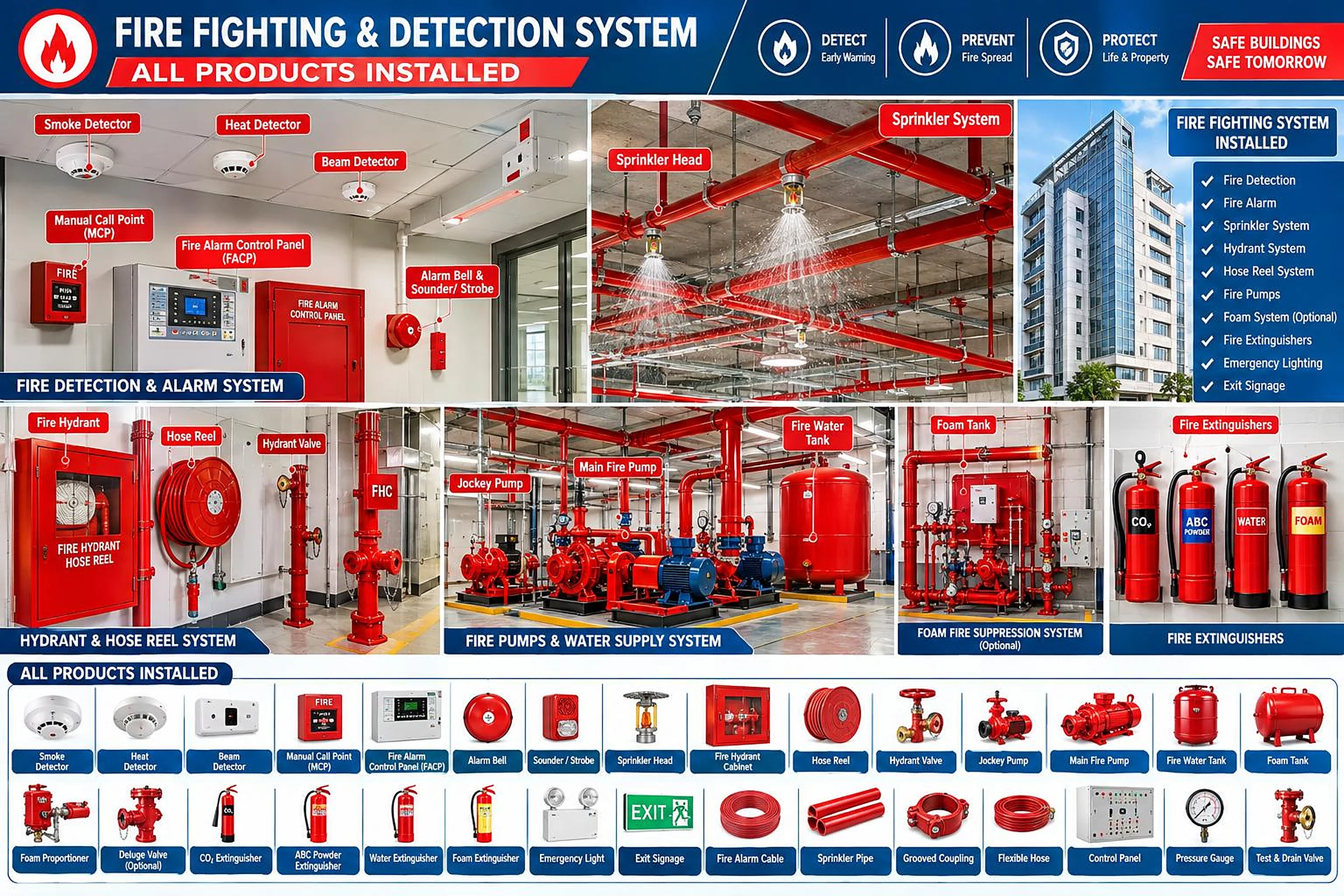
Fire fighting system installed
Detect — early warning. Prevent — fire spread. Protect — life & property. Safe buildings, safe tomorrow.
- Fire Detection
- Fire Alarm
- Sprinkler System
- Hydrant System
- Hose Reel System
- Fire Pumps
- Foam System (Optional)
- Fire Extinguishers
- Emergency Lighting
- Exit Signage
All products installed
- Smoke Detector
- Heat Detector
- Beam Detector
- Manual Call Point (MCP)
- Fire Alarm Control Panel (FACP)
- Alarm Bell
- Sounder / Strobe
- Sprinkler Head
- Fire Hydrant Cabinet
- Hose Reel
- Hydrant Valve
- Jockey Pump
- Main Fire Pump
- Fire Water Tank
- Foam Tank
- Foam Proportioner
- Deluge Valve (Optional)
- CO2 Extinguisher
- ABC Powder Extinguisher
- Water Extinguisher
- Foam Extinguisher
- Emergency Light
- Exit Signage
- Fire Alarm Cable
- Sprinkler Pipe
- Grooved Coupling
- Flexible Hose
- Control Panel
- Pressure Gauge
- Test & Drain Valve
Frequently asked questions
What is the role of a jockey pump?
A jockey pump maintains system pressure during normal conditions and reduces unnecessary starting of the main fire pump.
Smoke detector or heat detector — which one?
Smoke detectors suit areas where smoke is the early sign of fire. Heat detectors are better where dust, fumes or steam could cause unwanted smoke-detector activations.
How does a CO2 flooding system extinguish fire?
It releases a calculated quantity of carbon dioxide into a protected enclosure, reducing the oxygen concentration around the fire until combustion is interrupted. It is used for specially selected hazards where water is unsuitable.
What is the difference between hydrants and sprinklers?
Hydrant systems provide a high-flow water supply for firefighting personnel through hydrant points and hose reels. Sprinklers are automatic: they sense heat from a developing fire and release water over the affected area.